
Automotive Communication Protocols: CAN, CAN-FD, FlexRay, and K-Line
Embedra Inc.
Every modern vehicle relies on electronic communication protocols to connect its ECUs (Electronic Control Units). From engine management to electric power steering, these protocols are the nervous system of your car. If you work in EPS repair, understanding how these protocols function is not optional—it's essential.
In this article, we'll break down the four most common communication protocols you'll encounter during EPS diagnostics and repair: CAN, CAN-FD, FlexRay, and K-Line.
K-Line: Where It All Started
K-Line is the oldest protocol still in active use. Introduced in the early 1990s, it uses a single wire for bidirectional communication between a diagnostic tool and an ECU. It operates at relatively low speeds—typically between 1.2 and 10.4 Kbps.
While newer vehicles have largely moved away from K-Line for primary communication, you'll still find it in older EPS systems—especially in European vehicles from the 2000s and early 2010s. Many diagnostic routines, including ECU identification and basic fault reading, still rely on this protocol.
If you're working on older VAG or PSA group vehicles, K-Line is still your gateway into the steering ECU.
Key characteristics:
- Single-wire, half-duplex communication
- Speeds up to 10.4 Kbps
- Used primarily for diagnostics on legacy systems
- Defined by ISO 9141 and ISO 14230 (KWP2000)
CAN: The Industry Standard
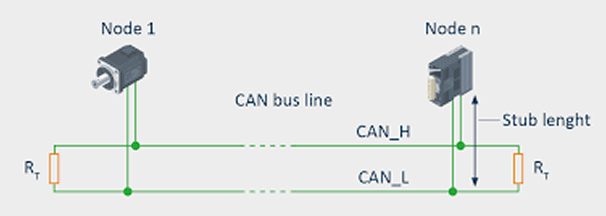
Controller Area Network (CAN) is the backbone of modern automotive communication. Developed by Bosch in the mid-1980s and standardized as ISO 11898, CAN is a two-wire differential bus that allows multiple ECUs to communicate without a central host.
In EPS systems, CAN carries critical data: steering torque values, vehicle speed, engine RPM, and diagnostic messages. When you connect a diagnostic device to an EPS unit, you're almost certainly communicating over CAN.
CAN operates at speeds up to 1 Mbps, which has been sufficient for decades. But as vehicles have become more complex—with ADAS features, electric drivetrains, and increasingly sophisticated steering algorithms—the limitations of classic CAN have become apparent.
Key characteristics:
- Two-wire differential bus (CAN-H, CAN-L)
- Speeds up to 1 Mbps
- Message-based, multi-master architecture
- ISO 11898 standard
- Used in virtually every EPS system manufactured after 2005
CAN-FD: More Data, Faster
CAN with Flexible Data-Rate (CAN-FD) is the evolution of classic CAN. Introduced by Bosch in 2012, it addresses two fundamental limitations: data payload size and speed.
While classic CAN is limited to 8 bytes per frame, CAN-FD supports up to 64 bytes. And during the data phase, it can switch to a higher bit rate—typically 2, 5, or even 8 Mbps—while maintaining backward compatibility with classic CAN during arbitration.
For EPS repair specialists, CAN-FD is becoming increasingly important. Newer steering systems from VAG, BMW, and others use CAN-FD for calibration data, firmware updates, and advanced diagnostic routines that simply require more data throughput than classic CAN can provide.
CAN-FD is not a different bus—it's the same two wires. But the data packets are bigger and faster. Your diagnostic tool needs to support it, or you're locked out.
Key characteristics:
- Up to 64 bytes per frame (vs. 8 for classic CAN)
- Flexible data rate up to 8 Mbps
- Backward compatible with classic CAN
- ISO 11898-1:2015
- Increasingly required for EPS calibration and programming
FlexRay: High-Speed, High-Reliability
FlexRay is a high-speed communication protocol developed by the FlexRay Consortium (BMW, Daimler, Bosch, Freescale). Operating at up to 10 Mbps, it was specifically designed for safety-critical and time-sensitive applications—exactly the kind of requirements that advanced steering systems demand.
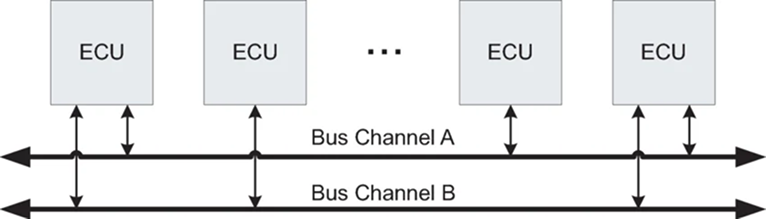
Unlike CAN, FlexRay uses a time-triggered architecture with deterministic timing. This means data arrives at predictable intervals, which is critical for systems like active steering, adaptive damping, and steer-by-wire.
You'll encounter FlexRay primarily in premium European vehicles—BMW (from 2006 onwards), some Audi models, and select Mercedes platforms. If you're working on these vehicles' EPS systems, your diagnostic tool must support FlexRay natively. There is no workaround.
Key characteristics:
- Dual-channel, up to 10 Mbps per channel
- Time-triggered, deterministic communication
- Designed for safety-critical systems
- Common in BMW, Audi, Mercedes EPS and chassis systems
- Requires dedicated hardware support—no adapter conversion from CAN
| Protocol | Speed | Payload | Typical Use in EPS | Era |
|---|---|---|---|---|
| K-Line | 10.4 kbps | Variable | Legacy Diagnostics | 1990s |
| CAN | 1 Mbps | 8 bytes | Standard diagnostics & control | 2000s - |
| CAN-FD | 8 Mbps | 64 bytes | Calibration, firmware, advanced diagnostics | 2015 - |
| FlexRay | 10 Mbps | 254 bytes | Safety-critical, active steering | 2006 - |
Why This Matters for EPS Repair
As an EPS repair specialist, you're not just fixing hardware—you're communicating with sophisticated electronic systems. The protocol your target ECU uses determines what diagnostic tool you need, what data you can access, and what operations you can perform.
Many legacy diagnostic devices support only CAN and K-Line. But if a customer brings in a 2020 BMW with FlexRay-based active steering, or a new Audi with CAN-FD calibration requirements, a limited tool means a lost job.
This is exactly why Embedra ONE was designed with native support for all four protocols—CAN, CAN-FD, FlexRay, and K-Line—in a single device, without external adapters. One connection. Full protocol coverage.
Your diagnostic tool should never be the bottleneck. If the ECU speaks it, your device should understand it.
Looking Ahead
Automotive communication is continuing to evolve. Ethernet-based protocols are emerging for high-bandwidth applications, and the complexity of EPS systems will only increase as vehicles adopt more advanced driver assistance features.
Staying informed about these protocols isn't just technical curiosity—it's a business necessity. The repair specialist who understands the communication layer has a decisive advantage over the one who doesn't.
#K-Line
#CAN
#CAN-FD
Share this article on: